What People Did at 3 a.m. in 1700
Waking between the first and second sleep was ordinary. Here is how people spent that hour, from prayer to pilfering.
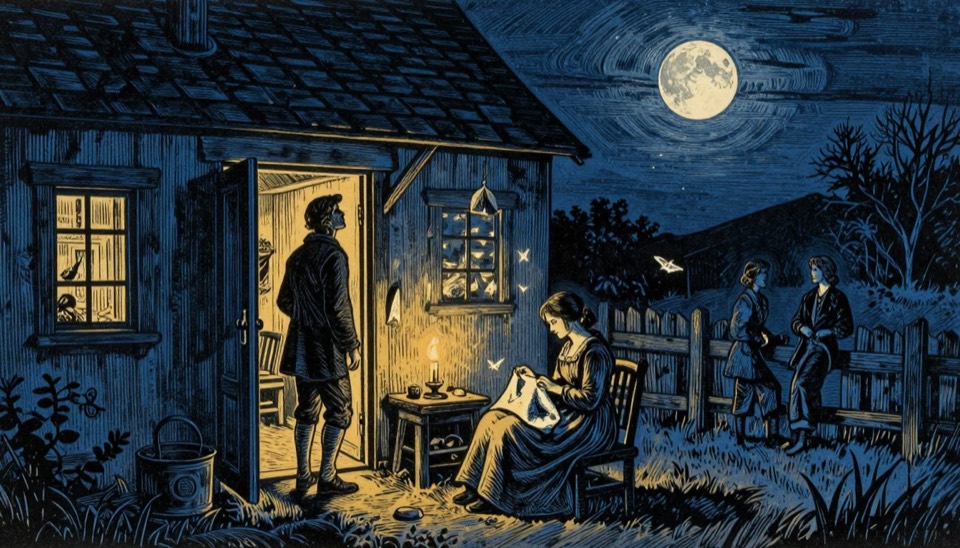
In 1700 many people in Europe woke for up to an hour between their first and second sleep. Most stayed in bed to pray, think over their dreams, talk with a bedfellow or make love. Some got up to do chores or visit neighbours. A few used the dark for mischief. Historian A. Roger Ekirch, who gathered the evidence, says people did "anything and everything imaginable".
The hour didn't fall at 3 a.m. for everyone. Most people went to bed between 9 and 10 p.m. and woke from first sleep around midnight or later, so the time depended on bedtime and the season. On this site we call that hour the watch. Old devotional writing uses a similar phrase: in 1710 the minister Matthew Henry wrote of waking from first sleep "in the Night-watches".
For the wider story, read First Sleep, Second Sleep: How People Slept Before Electric Light.
Prayer
Prayer was one of the most common uses of the hour. Prayer manuals from the late 15th century offered special prayers for the time between sleeps. In 1679 the clergyman Christopher Jelinger described his own devotions on waking from first sleep. A few especially devout clergymen gave up second sleep altogether to pray and study, and people noticed because it was rare.
Talk and Love
The hour wasn't always solitary. People often chatted quietly with whoever shared the bed, if that person was awake too. Couples made love. Doctors approved. A 16th-century French manual told couples that the best time to conceive was "after the first sleep", A French hygiene manual from 1826 still named the waking after first sleep as the best moment.
Dreams
People often woke straight out of a dream and had time to think it over in the dark. Ekirch found many accounts of people reflecting on dreams in this hour. In 1737 the Lancashire doctor Richard Kay wrote of dreams that brought him to his knees "in the dark and silent night".
Getting Up
Others got up. They went to the privy, smoked a pipe or did household chores. Some even went out to visit neighbours. The scholar Erasmus wrote that he worked "while waiting for the second sleep". Medicine was part of the routine too. Many medical texts of the 1600s and 1700s told patients to take their doses in the interval after first sleep.
Mischief
The dark hid less innocent errands too. Ekirch's examples run from saying prayers to stealing a neighbour's chickens, and some people used the hour for petty theft. A joke book from 1720 tells of a man who woke after his first sleep to find thieves in his house.
Lying Still
Many people did nothing much at all. They lay in the dark, rested and waited for second sleep to come. Nobody seems to have thought this strange. In the records, waking in the night is mentioned in passing, as an ordinary part of the night, and second sleep is expected to follow.
Sources
- Ekirch, A. R. (2001). Sleep We Have Lost: Pre-industrial Slumber in the British Isles. The American Historical Review, 106(2), 343–386.
- Ekirch, A. R. (2005). At Day's Close: Night in Times Past. W. W. Norton.
- Ekirch, A. R. (2024). Reflections on 'Have We Lost Sleep?'. Medical History, 68(3), 254–262.
- Ekirch, A. R. Segmented Sleep: selections from historical sources. Virginia Tech.
- Virginia Tech College of Liberal Arts and Human Sciences (2017). Sleep, Interrupted. ECHO magazine.
- Hegarty, S. (2012). The Myth of the Eight-Hour Sleep. BBC News Magazine, 22 February 2012.
- Gershon, L. (2017). The Age of the Bed Changed the Way We Sleep. JSTOR Daily, 27 November 2017.